The Data Says Argentina Was Meant To Lose
The final scoreboard may have been 0-1, but that was because Argentina got lucky.
20 Jul 2026 · 8 min read
Time To Do Some Soccer Science
July 19, MetLife Stadium – As the 120 minutes lapsed, Spain beat Argentina in a 1-0 as Ferran Torres scored in the 106th minute following Enzo Fernandez’s second yellow 3 minutes after 90 the 90 minute game time. However, the most interesting outcome here isn’t the scoreline but the statistical conclusion (that happens to be much stronger as well):
Argentina’s loss did not mainly occur because of a single late dismissal or one finish. Their attacking and ball progression system had already failed comprehensively even at 11 vs 11. The red card was followed by (but more likely just intensified) a deeper imbalance that existed from the start. And at the same time, Spain’s superior territorial control and bench depth converted their sustaining pressure into a single winning goal.
So here’s the process based conclusion for my nerd-readers who are insane enough to continue beyond this point: SofaScore’s phase feed had Spain ahead in shots by a margin of 15, or in simpler words +infinity % more than Argentina who managed to make 0 shots in the 120 minute game. Similarly, they were up on expected goals during regulation 1.19-0.00 even before the dismissal could affect extra time. Even FIFA’s post match tally showed to official shot attempts by the Argentinians at 116 and 121 minutes, both after Spain scored. And their own model values them at just 0.07 xG (expected goals).
The Data Has A Story To Tell
If we simply look at more detailed data, I think it becomes quite clear that the break was upstream of shooting. When looking at line-break completions, Spain led Argentina with 80.5% compared to 58.8%; the Spaniards managed to break through the Argentinian defensive lines 22 times compared to a measly five; and as for receptions in the final-third of the field, Spain was 5x higher than Argentina.
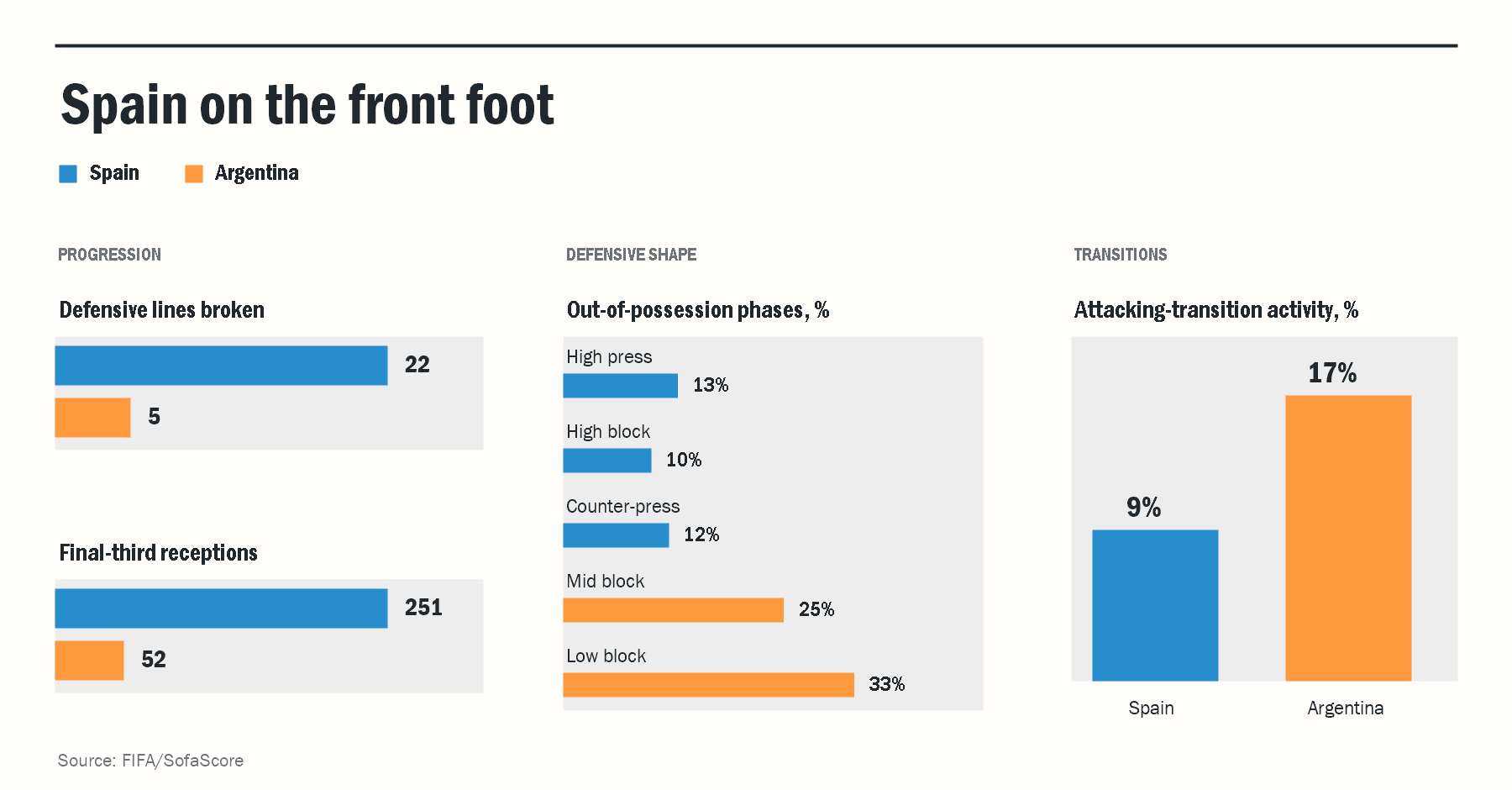
Classifications that are based on phases show the same story again: Spain delivered severe high presses/blocks and counter-presses. Argentina, though, had its largest non-possession categories in the mid/low blocks (25% and 33% respectively). Credit where its due, they did have more attacking transition activity than Spain but they still managed to only register a 1% counterattack and no shots on target (if you looked at the Argentinians in the match, you’d think they were deliberately stalling).
And this throughout match data just re-inforces the point that Enzo’s red card dismissal may have been a key event in the match, but it was certainly not an equalizer. Spain had been dominant even with him on the field. Argentina had no shots during regulation and both shot tries only came in the last 5 minutes of the game after Ferran’s winner.
If we look at prior research into the dismissal phenomena, it’s clear that the side that has a player evicted obviously faces its scoring rate going down while the opponent’s increases (the magnitude of this change is dependent on the timing and the side sanctioned). And as such, after the red card, Spain held possession 73% of the time and led with 4 shots (creating a 0.53 xG).
Let’s Sprinkle In Some Probability
xG = sum of estimated scoring probabilities of shots
This is not a deterministic statement, that a 1 xG would definitely lead to one goal. It is a measure of chance quality and the process (which we can quantify using things like the distance from goal, angle, body part used and even looking at player positions in certain cases).
We specifically have two providers to work with here, SofaScore and FIFA, for this data. And we can use a conventional (independent) Poisson approximation twice (a reminder again, these are no “true win” probabilities in any way).
The 0-0 in regulation was the less intuitive part in our scenario, with Spain having an xG of 1.19 and Argentina at zero, the probability that Spain would fail to score is e^(-1.19) which is ~30%. So Argentina even getting to extra time was unlikely (but ig not a miracle). As an observer I would attribute that to the Spanish under finishes and to Argentina’s excellent shot stopping.
Just to provide some attribution to the horrendous Argentinian xG, let’s dream up this scenario: you have 22 shot opportunities (considered independent and equally likely for either team). In this case, the chance to get a 20-2 split between the two teams is 0.01%. I guess this means that you just miss the shots you don’t take.
Argentina’s Abnormal Attack Mechanism
So before every game FIFA released a technical study report, which gives us good pre-game hypotheses on what analysts thought (marginally cuts down the hindsight bias). And the report described Spain as a team who counter-presses, has high volume possession, probes inside channels and has substitutes carry them forward a lot. Argentina, on the other hand, looks a lot different. Nine players spend 2/3rd of the game defending and recovering for Messi and then try to get him the ball for scores in the final third (Lionel had been involved in 99/113 Argentinian chances).
For the Spanish, they played exactly as described:
- Spain escaped Argentinian pressure with a 90% pass completion rate and 80% attempted line breaks. Argentina had spent more time with the ball and as such registered more pressures (445 to 300), but that didn’t turn into more forced turnovers than Spain. Pressure volume -/- effective disruption. And since most completed passes were in the final third, this was very harmful pressure for the Argentinians.
- Spain sealed the central attacking route. Argentina managed to produce zero regulation shots and only two opposition box touches, with a 63% completion rate in Spain’s half. The Spaniards on the other hand completed 85% of theirs. Argentina’s Martinez was their leading source of attempted final-third passes (proof of Spain forcing them to bypass the midfield).
- Messi became a stable horse who couldn’t run. Only one dribble through regulation (he was at 9 in the semis). But it’s not just his fault, Argentina’s model deliberately spares him from defense. Against the tripartite Spanish counter pressing, the Argentinian nine could neither close their build-up nor give any stable possession to their chance creator.
- Argentina lost width at half time. Gonzalez replaced Paredes. Another central midfielder didn’t improve the attack as possession in the second half dropped to 32%. The manager most likely sought central control, however, it failed (and took away a natural wide runner in the process).
Maybe That Red Card Was A Blessing
If it were not for the red card during extra time, people might have remembered Argentina losing due to their abhorrent playing strategy. But thankfully, it shall act as a veil in football history for the average joe.
We on the other hand are not average joes. As we have seen, Argentina failed to produce any alpha throughout its entire regulation time. On the red card front, though, I would add that it reveals a problem in Argentina’s risk taking and decision making. They used up all 5 substitutes, so they couldn’t get Fernandez out after his first yellow. And the team played with no discipline; while both sides played aggressively (Argentina only had 4 extra fouls), they managed to accumulate all the cards.
Spain’s Substitutes Produced Action
Spain introduced 2 substitutes at 62 and 75 minutes each. And it was these substitutes who made the goal: Williams assisted Torres for the winning move. The goal was a moderately difficult change that finished with incredible placement: 0.22 xG before shot and 0.6 post placement on target.
Our theory yet again matches the pre-match technical study, FIFA’s observation was that Spanish subs had always maintained or elevated performance through late knockout goals.
Argentina Had One Stag
Despite the disappointing attacking performance, how did Argentina maintained a 0-0 until the 106th minute. Well we our man of the match successfuly holding the goal line: Martinez outstandingly managed 11 saves (4 of them “big saves”) and had a +1.76 goals prevented score on SofaScore.
The defense certainly did help good on keeping the team away from the goalmouth, since 11 out of 20 shots for Spain had to be taken outside the box (78% of tackles won). All to say, had they survived another 15 minutes, Martinez could have gotten them the win.
But I guess they knew the risks going in, a strategy that relied on taking the stellar goalkeeper to penalties just had a margin of error of 1.
Well Here’s Some Alternative Strats For Argentina
These are just my recommendations based on counter factuality; one change alone wouldn’t have certainly reversed the result.
- An asymmetric 4-4-1-1 with Alvarez pressing centre-back and curving to Rodri with Messi occupying that receiving lane would have the midfield line close enough to counter-attack Fabian’s touches.
- Do not remove Gonzalez for Paredes, instead preserve that wide transition outlet. It would have stretched the counter-pressing and created an escape route for after recoveries.
- Adapt. At 60 minutes with no shot, they needed a new attacking profile. A new creator brought in with a wide runner would have at least tested the opposition (injuries did restrict the choices here but the team also had no motivation for any of these changes).
- Keep some substitution capacity for yellow-card risk management. And even after the red, maintain some capacity for counter-pressing.