The Easiest Data Creates The Easiest Map
The FT's attempt to turn Facebook data into a map of where friendships come from is plainly unscientific.
7 Sep 2026 · 3 min read
The FT’s Friends with fiscal benefits makes a fairly intuitive argument: knowing people across class lines leads to upward mobility and, as such, universities are good places to make those connections (a point I couldn’t agree with more after my first week here).
But what I remain less convinced about is how confidently we can turn Facebook data into a map of where friendships come from.
Before my rebuttal, I’ll begin by fixing the FT’s chart crime (no 40% is not 4 times 20% and yes, you shouldn’t use two pie charts to compare such skewed label data). Enjoy!
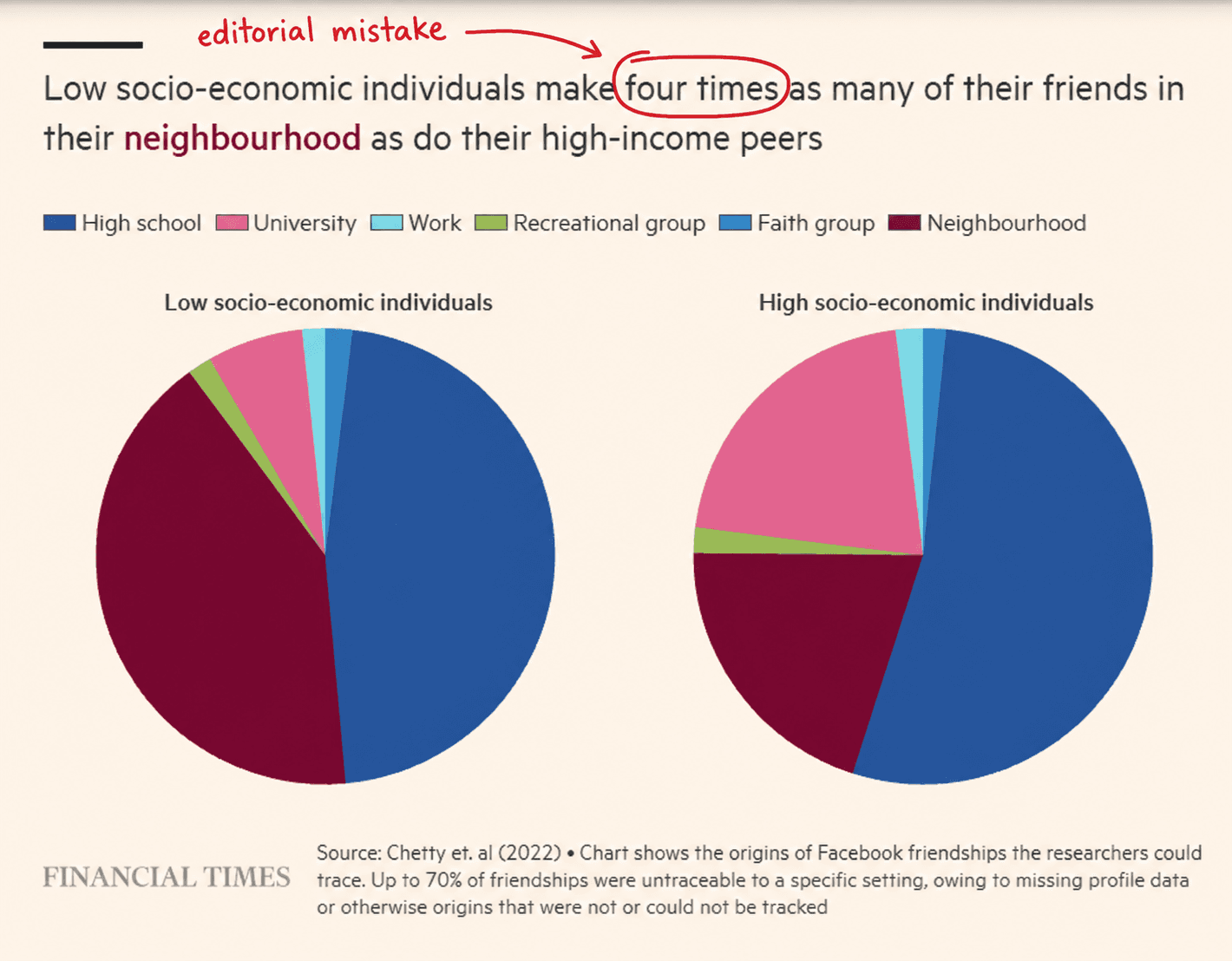
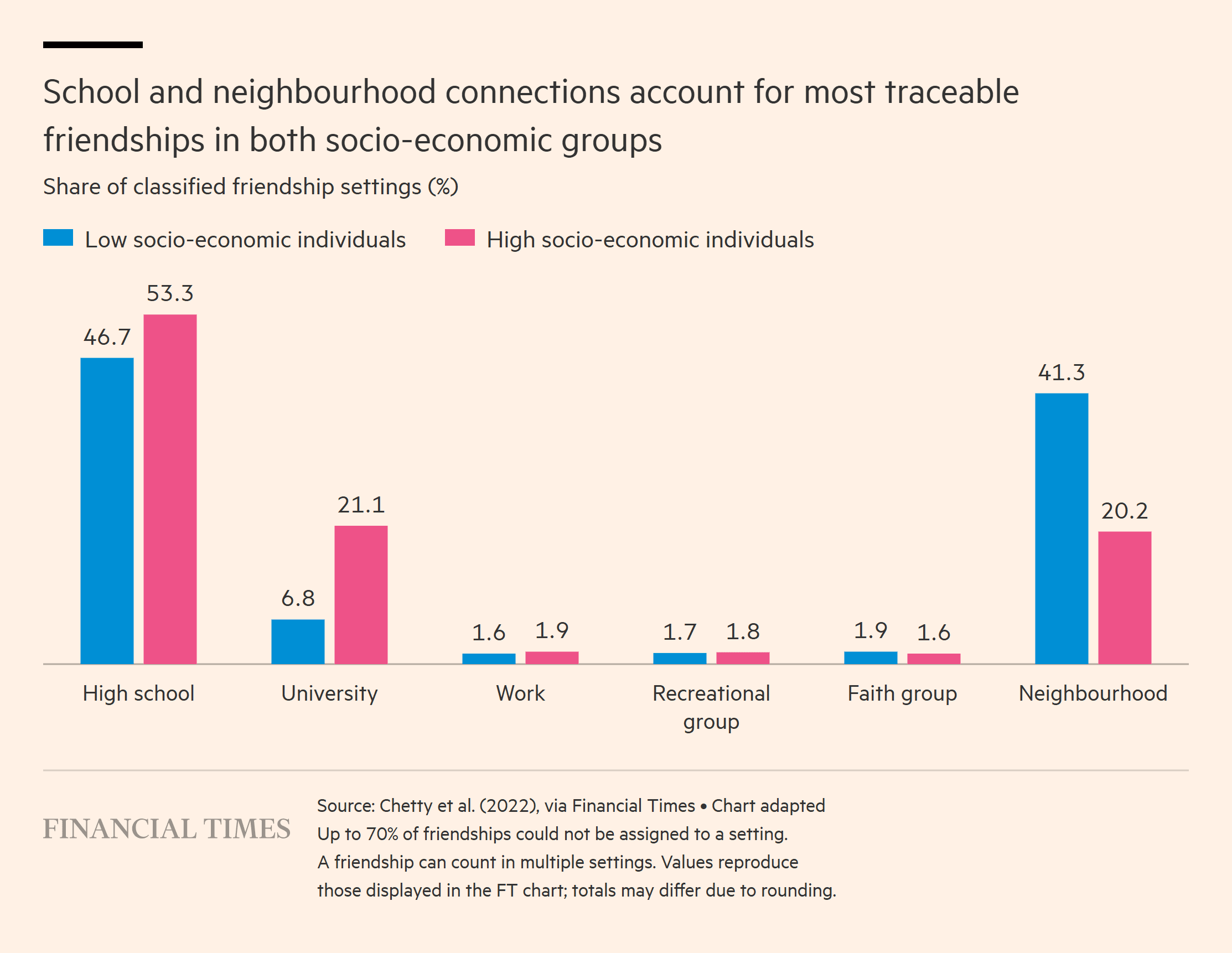
Roughly 70% of friendships could not be assigned to a setting, that itself should make the analysis pause. The researchers could see friendships, but couldn’t connect them to one of six settings they studied. The 2 fairly obvious reasons being, the data didn’t exist and the researchers didn’t have any way to map recreational activities (I would think the best way here would be to scrape member information from 1000s of small hobby groups and then map them onto the data, but I digress).
Think about the Facebook profiles people created sometime between the mid-2000s and a decade later. The first obvious thing to put was your high school, university, maybe your employer (and many wouldn’t want this to be a public association to avoid their company finding their beach picnic celebrations).
These things were: recognizable, had dedicated fields, and obvious reasons to fill them. Just think about the nostalgic rom-com characters signing up to reconnect with his high school buddies. Of course he puts his school front and centre. That’s why he’s there.
In case the movie reference doesn’t help, I found this 2007 paper, surveying 286 MSU undergraduates, where 96% of Facebook users listed their high school. Keeping in touch with old friends scored 4.42 out of 5 as a use of Facebook; meeting new people scored 1.97. I’m sure that use cases/mindsets to profile building evolved since 2006 but this gives us evidence for why school connections might leave unusually good records.
You can’t enter “bumped into each other at a party, became close during a breakup, now play pickleball together”?
Now, the obvious objection: did the researchers really overlook this?
They didn’t. They adjusted for under-reporting and found similar results, which makes our objection less conclusive. But they couldn’t make that adjustment for recreational groups because they lacked reliable figures for how many people actually participated. So the correction still leaves part of our question unanswered.
And friendships shared across multiple settings were counted in each: this method won’t establish which setting started the friendship.
Did this prove that schools are overrepresented? No, but we have a plausible reason they could be, evidence supporting that and an unresolved question about friendship origins.
The FT does qualify its comparisons as applying to traceable connections. Fair enough. But that qualification should also limit how much we infer from them.
The easiest data available created the easiest map available – but that’s not enough to explain how our society works.