The Future Is Too Important To Leave To The Bureaucrats
The bureaucratic class fails to understand that the pursuit of a greater good sometimes demands sacrifices.
13 Nov 2026 · 8 min read
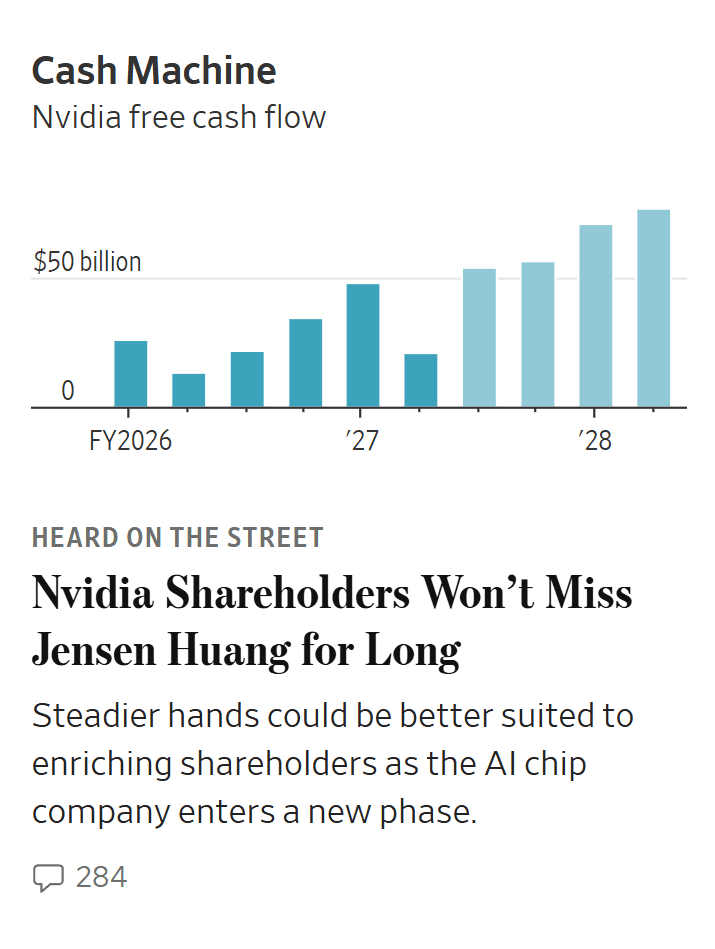
From the Economist’s “Jensen Huang Must Resign” to the Wall Street Journal’s opinionated “Heard on the Street”, journalists have come out to crucify Jensen Huang over his affair(s). Were you a conspiracy theorist, you’d call this level of disdain nothing short of a coordinated smear campaign.
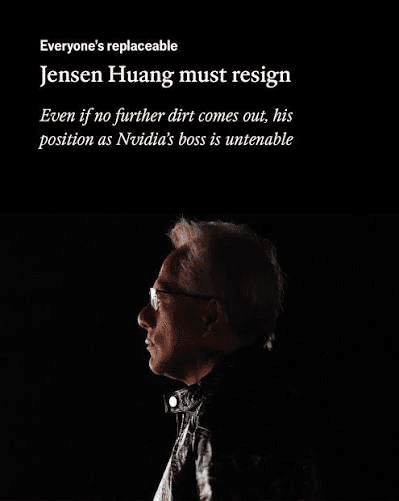
But to bend to the will of a bureaucratic class that has failed to create anything of measurable value would be a disaster in its own right.
Forcing out the most consequential founder of the most consequential technological revolution is not just a disservice to his decades of work, but to everyone who stands to benefit from it.
The Punishment Has Been Decided, But We Still Don’t Know The Crime
While the New York Times broke the story of the affair between Jensen and Alice Huang on the 9th of November (alongside allegations of her being a “Chinese spy”), we still have no concrete details on what Alice or Jensen (for that matter) have done.
In fact, despite its suspicions about Alice’s foreign allegiances, the USG decided not to intervene. CNN reported today that the CIA itself is not convinced that she was funneling information to Beijing’s MSS. Similarly, Nvidia’s own board states that neither national security nor company secrets have been compromised.
So what is the established crime here? Infidelity? Well, bad personal judgement sure. But grounds for removing him from Nvidia? For his lapse of judgement, Jensen will likely end up in a divorce settlement that strips him of half his wealth and company (just like Gates and Bezos).
So, NatSec Aside, What Remains?
Well, the founder and CEO’s primary duty is to his shareholders, so do they want him gone? No, they don’t.
Since the news broke out, Nvidia’s stock price has crashed and price targets been lowered. The most vocal investment community (on X) have repeatedly grabbed their chests as the board’s plans to fire Jensen came out. And why would they not? Jensen is, undoubtedly, the most well connected, knowledgeable and product-oriented CEO in his industry.
From securing RAM capacity by singing karaoke with Samsung executives in Seoul to locking out competitors from getting TSMC allocations over fried chicken in Taiwan, Jensen has managed to steer his supply chain in advance to avoid so many obstacles that slow down others.
He bet on parallel computing a decade early, at a time when the world didn’t even think much of machine learning. To this day he continues to support his early customers (gamers) by making consumer GPUs when that capacity could generate multiples more through enterprise.
Even putting X aside, I’ve met two wealthy Nvidia investors over the last 24 hours who have both talked to me about the same topic: “how stupid do you think the board is being?”
Hell, even Elon Musk, arguably Jensen’s most ambitious competitor right now, has been tweeting in his support. And he’s not the only one. Tim Sweeney, who is usually quite quiet about such topics thinks that kicking Jensen out is analogous to Steve Jobs’ exit from Apple in the ‘90s. There’s more: Naval, Bill Ackman, Delangue, Nikesh Arora…..
The Employees Have Spoken. Apparently, Nobody Listened
I must say, I do sympathize with the argument of listening to the employees a lot. And you know what, people are right.
Jensen had an affair with an Nvidia employee, so we can’t keep them out of the conversation – especially considering that 88% of surveyed employees on Blind showed support for Jensen to continue. I’m fairly certain that’s higher than what Altman had during his OpenAI saga.
And it’s no surprise why. Beyond the fact that Jensen has led the company so impeccably that even interns have become millionaires, he is the kind of CEO any aspirational employee would want. He is technical, he cuts straight to the chase and he focuses on work over “managerial structures”. Jensen alone has 60 direct reports. That’s unheard of at anyone’s scale, let alone at his.
Employees respect a CEO who came from humble beginnings and continues to work his ass off after 3 decades (and allows them to, quite literally, change the world).
Oh, And What About The Rest Of Humanity?
Nvidia’s interests aren’t the only ones at stake here, what about the rest of us? How can this one decision affect everyone’s futures? There is no doubt that AI is the most transformative technology our civilization has built (if this remains a point of contention, I’m surprised you made it this far).
Regardless, the most transformative technology is shaped by leaders who are just as ambitious about it. It was Steve Jobs who gave the world the iPhone, it was Elon Musk who enabled space as a business and electric vehicles, it was Henry Ford who spearheaded manufacturing and it was Jensen Huang who enabled the AI revolution.
A decade ago, few could forecast the incredible impact that machine learning would have on the world. But Jensen did and he almost gambled away Nvidia on CUDA, when the simpler and much safer route was to simply create a dedicated-gaming chip, not a general purpose platform.
Losing the man in the leather jacket right as we enter the steepest improvement curve in AI (and an enabling curve in robotics) might cost society more than we can fathom. Especially when you consider that the cost of allowing him to lead remains nothing in comparison.
This is not to say that the industry is nothing without him, but even just a one year setback in a cure for heart disease, diabetes or cancer would have incredible human costs. That possibility deserves a place in the calculation.
In The End, It’s Founders Who Lead
The WSJ’s opinionated Heard On The Street welcomes a future where Nvidia sits on billions in cash flow and plays corporate America’s favorite sport: buybacks. But it fails to understand the growth and innovation founders bring. More importantly, it can’t see beyond filling the pockets of individual Scrooge McDucks.

Don’t get me wrong, I am just as capitalist as the next guy. Probably more.
But in comparing Nvidia today to Apple after Steve Jobs’ passing, the WSJ points to Apple's trillions in shareholder value under Tim Cook as proof of the virtues of “professional management”. But do we just ignore innovation and progress entirely? What did the biggest company in the world have to show for its 15 years of raking in cash? A $15B failed EV program?.
Steve Jobs took the upstart, the iPod, and used it to revolutionize the world by creating the iPhone. He might be the reason why you’re even able to read this today. So just imagine what he could have accomplished if he had a trillion dollar war chest.
You don’t necessarily have to imagine. Just look at Mark Zuckerberg using his ad-money war chest to fund the development of Reality Labs. The concept still seems freakish to me, but Meta has managed to create incredibly lightweight AR tech that could change the way we interact with teh world. This probably could’ve just as easily come out of Apple had they dared to dream.
Same thing with Brin and DeepMind. Bezos with Blue Origin. Musk with SpaceX and Neuralink.
Ambitious founders dream, they dream beyond corporate profits, they dream to create a better future. Something our egocentric, incompetent and insecure commentariat seems incapable of understanding.
Ambitious investors know this. It’s why Brian Halligan’s return to HubSpot was welcomed with an 8% pop, the same day Nvidia fell by 8%.
The same logic can extend to AI in general. Many analysts, journalists, politicians, and investors regularly go on TV to criticize the current AI buildout. Sure, I agree with you, it may be unsustainable. Maybe even unprofitable. But there is a prospect of solving our planet’s most important problems here. Should we forego that future to ensure profitability?
While I don’t necessarily agree, someone put it far better than I can:
Superintelligence may in fact be the last thing that Silicon Valley gifts the world, which will likely be followed by its own demise.
Well….
I don’t know what Nvidia’s board is thinking. But society needs to look beyond the cancel-culturists, the small-minded bureaucrats, those who would sacrifice a much better future for the satisfaction of taking down a founder.
We need to believe in and build a future that’s 100x better than today.
PS: And if you’re a founder, just make sure to get yourself a dual-class share structure and spend a lot of time auditing your board. Should save you a lot of headache down the road.